staying curious as a first principle
for the easter egg bunnies out there, the footnotes1 are sidequests to feed your own monotropic wyrmholes. choose your own adventures, and enjoy!
blather
Over-optimisation is the feng shui of systems architecture — some fool, some time ago
…or someone the early stages of a deeper understanding of their process? That depends on your chosen lens.
Mine says: why not both?
the happiest accidents
I have come to realise that most of my smart optimisations are stumbled upon, and developed, often unconsciously, sometimes for decades before I can surface a notion, let alone a deep understanding of why the fuck I do what I do.
In autistic circles, we sometimes refer to ourselves as having “spiky profiles” 2 — yes I may look like a clusterfucked jibber much of the time, and yes I am, thank you for asking, but if you spend the time to coax and tease and play around with our mess, then the upside has legs a mile long. Not only for our personal well-being, but for those who collaborate with us, and those who build systems (even for-profit products that deliver).
Let’s break the jibber down.
circuitous routes
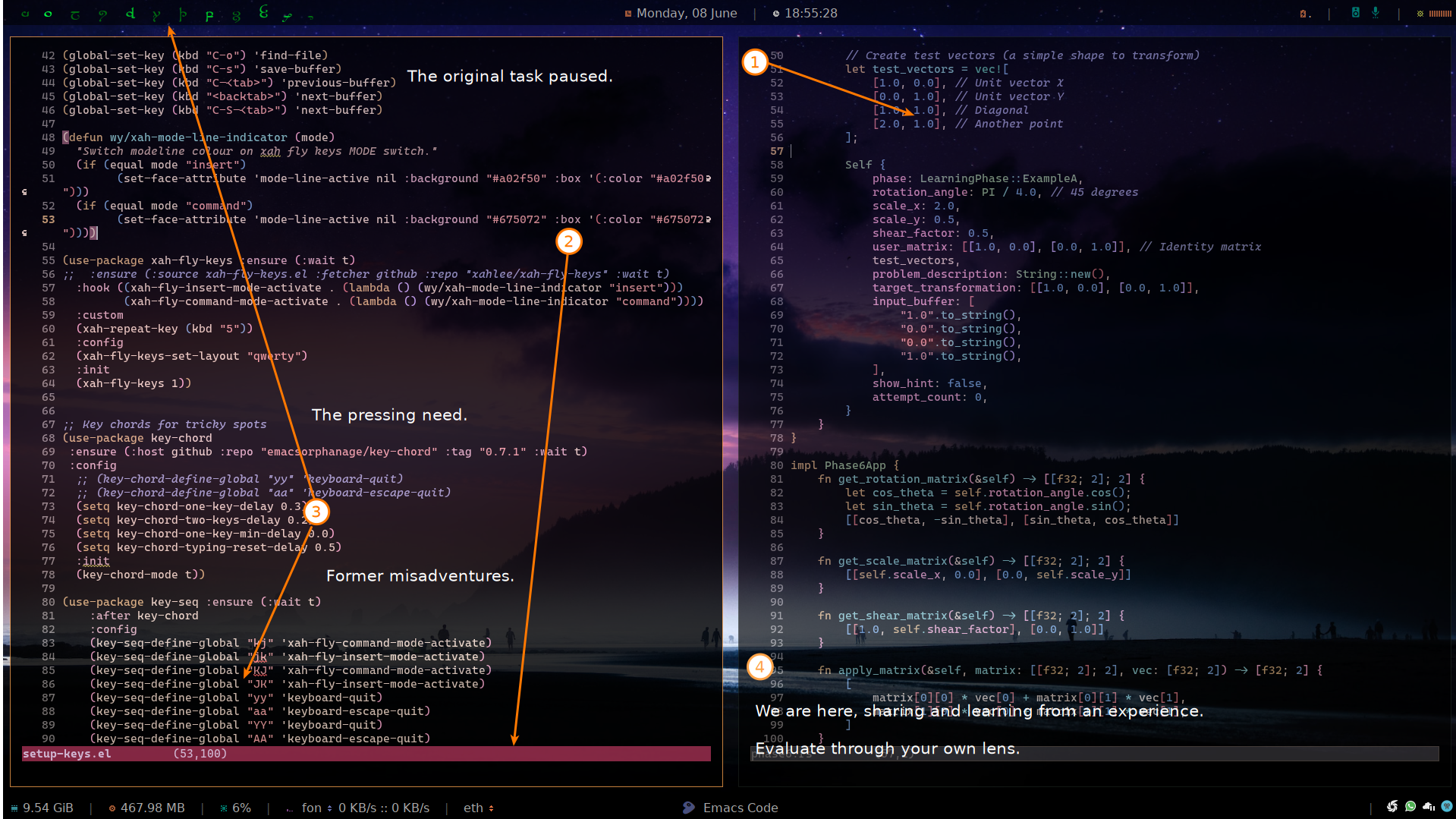
Figure 1: one man’s higgeldy-pig…
I will touch lightly on the higgeldy pig path that led to this post. The specifics are to a large extent irrelevant beyond my own very-specific worklows, and info-dumping3 only serves to distract from the message here.
While I was spending some quality time trying to learn something pragmatic and sensible (coding and maths), I felt a pressing need to scratch an itch in the form of a bugfix for a bug I’d introduced to my Editor some time ago–colouring part of the editor to indicate that I was in Editing vs Command mode.
As I worked through this process, I was observing my patterns, and most critically my emotional and mental states through a lens finally able to accept my autistic experience, and tooled with the Ausome wisdom of many autistic experiences I have been lucky enough to interact with. <3
While I tinkered and skipped between tasks, I noticed a glimmer of joy rippling through me, and felt a need to share that with and for others. I began conversationally bouncing my understanding off a dreaded Ellellemese4, and watched my quickly shifting emotional states, I started to draft and synthesize my thoughts first into a log, then stub report, then blog post you are currently reading.
breaking it down
Much of what I do seems really just strange loops5 echoing at different scopes. It’s somewhat galling, and healthy, to consider how easily decades of obsessive workflow process could be reduced to something scribbled on a napkin with room to spare.
Stimming — in this context, a stim is finding ways to blow off enough nervous energy to focus and distract ourselves into a monotropic flow state 6, which builds strong buffers that anxiety away like it’s not even there. We redirect the discomfort into something positive. I am constantly rocking to music and “ghost typing” at 2-3 times the speed I actually type when I stop for a moment.
Dividing attention — I have found the best fit for my regulatory architecture is to split my attention between two to four projects at any given time. This avoids a crash of overwhelm stuck inside one pressurized task. Resistance levels overflowing on task A? => flip to B or C. B now slowing to the point of boredom? => back to A or C. Rinse. Repeat.
Finding flow - as my bodymind7 invests in the task at hand, the necessity for these crutches falls away, and I find myself lost to the outside world, fully invested in the flow state8 that gives such rich meaning to my (and many other) autistic experiences. It is not the only factor in a healthy lived experience, but it’s a critical piece. It is a major upside of many autistic experiences.
Most if not all of my workflows follow these patterns eventually, and they found themselves, long before I could even begin to notice them beyond surface level, let alone define them.
choose your own adventures
An itch so mild it never needs scratching for most, led me to the most unproductive of productivity optimisations. That has profound upside to my personal understanding, growth, and the joy of just doing a job. That’s some of my journey’s upside. I believe, at my core, that we all have that value, and the capacity for that joy for ourselves and others within reach.
The scaffolding I’ve found to best meet my Autistic self where I’m at (along with ADHD, perhaps a PDA9 drive, and some schizoid leanings) would not be the same even for this specific subtype of subtypes, had simply chosen fiddly electronics, or motorcyle maintenance over software. That’s without introducing the layers of nuance via the ups and downs of family, Irish, and other cultural scopes unique to my experience.
Even a brief consideration of these many dividing paths, and the countless beyond, arrives quickly at a place where we must choose our own adventures and find our own fits. Yes, autistic people are skilled at these custom designs inherent in our life experiences — uncomfortable in ill-fitting suits. But I believe all humans desire and benefit from this nuanced understanding of self.
stay curious
That’s why I find it important to be open, curious, and playful in exploring and discovering what works. Trust yourself, because cynicism is a blocker to self-understanding and the creative process in many contexts.
I hope to jibber all the way through this strange, looping adventure. Within mostly reasonable ranges of anxious joy. This explainer of my process was thrown together in a scattered, higgeldy pig side quest while tinkering with a colour scheme change designed to warn me I was in edit mode while learning a new programming language. That is my quasi-chosen path of continuous learning and growing. Enjoy yours.
Feed your monotropic wyrms… ↩︎
Spiky profile refers to the uneven distribution of abilities common in autistic people — areas of exceptional strength sitting alongside areas of significant difficulty, rather than the broadly even profile seen in most neurotypical assessments. ↩︎
Info-Dumping is the familiar autistic process of flooding anyone willing to listen (and not) with our favoured obsessions. ↩︎
Ellellemese :: current sid-visciousest bffs, future overlords, fancy word clouds, and worst and best thing to ever happen since next tuesday and nothing in between. ↩︎
Strange loops are sometimes paradoxical loops occurring at different levels of an abstract system that somehow seem to end up where they started. ↩︎
Monotropism is a theory of autism developed by Dinah Murray, Mike Lesser, and Wendy Lawson. It proposes that autistic people tend to focus their attention intensely on a small number of interests at a time, creating deep tunnels of engagement rather than broad shallow attention. ↩︎
Bodymind is the holistic view of the mind as an inseparable intertwined part of the body. ↩︎
A flow state is total immersion in the task at hand, synchronicity of investment of the task at hand by the emotional, physical, and mental energies. ↩︎
PDA (Persistent Drive for Autonomy) is a profile associated with autism characterised by an intense need to resist and avoid the demands of everyday life, driven by anxiety rather than defiance. The name is contested — many prefer “Persistent Drive for Autonomy” over the original pathologising language of “Pathological Demand Avoidance”. ↩︎